InsightsNo. 2China
China's humanoid robots: 215 of 337 current models, and where the top shipping country stands
Translated from the Korean edition (Korean text as of 2026-11-21) with AI and checked by a person.
Summary
- Where things stand
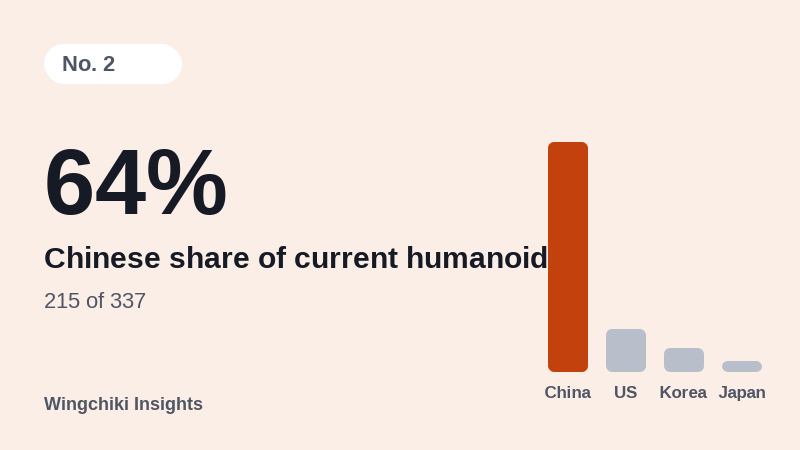
215 of 337 current humanoids (64%) are made by Chinese companies, and 115 companies make them. China was counted as 78–97% of global shipments in the first half of 2026.
- Analysis
China's strengths are priced products, parts sourced at home and steady investment. But shipments are concentrated in Unitree and AgiBot, and 86 of the 215 models are still prototypes.
- Conclusion
China has already become "the country that sells the most", but whether it is "the country where robots replace people's work in factories" has not yet been proven in numbers.
At a glance
2026-10~2026-11
- 4 of 9 newly unveiled humanoids are Chinese (44%)
- New Chinese models: H2-X (Unitree), InoBot W1 (Inovance), ASD-S2 (Aishida), Jiling-S1 (纪灵-S1) (Zhongke Diwuji)
- 2 funding records for Chinese companies, disclosed total about $150M
- 12 supply records with a Chinese supplier (by record date) (2 official)
2026-08~2026-11
- 20 of 32 newly unveiled humanoids are Chinese (62%)
- New Chinese models: H2-X (Unitree), InoBot W1 (Inovance), ASD-S2 (Aishida), Jiling-S1 (纪灵-S1) (Zhongke Diwuji), Mantis Standard (小白) (Lanchong) and others
- 5 funding records for Chinese companies, disclosed total about $1.05B
- 26 supply records with a Chinese supplier (by record date) (4 official)
2026-05~2026-11
- 42 of 61 newly unveiled humanoids are Chinese (69%)
- New Chinese models: H2-X (Unitree), InoBot W1 (Inovance), ASD-S2 (Aishida), Jiling-S1 (纪灵-S1) (Zhongke Diwuji), Mantis Standard (小白) (Lanchong) and others
- 14 funding records for Chinese companies, disclosed total about $1.61B
- 27 supply records with a Chinese supplier (by record date) (4 official)
2025-11~2026-11
- 92 of 142 newly unveiled humanoids are Chinese (65%)
- New Chinese models: H2-X (Unitree), InoBot W1 (Inovance), ASD-S2 (Aishida), Jiling-S1 (纪灵-S1) (Zhongke Diwuji), Mantis Standard (小白) (Lanchong) and others
- 39 funding records for Chinese companies, disclosed total about $5.11B
- 47 supply records with a Chinese supplier (by record date) (13 official)
All records
- 206 of 372 newly unveiled humanoids are Chinese (55%)
- New Chinese models: H2-X (Unitree), InoBot W1 (Inovance), ASD-S2 (Aishida), Jiling-S1 (纪灵-S1) (Zhongke Diwuji), Mantis Standard (小白) (Lanchong) and others
- 103 funding records for Chinese companies, disclosed total about $7.85B
- 51 supply records with a Chinese supplier (by record date) (15 official)
As of 2026-11-21 · data dates are monthly, so the month of the reference date is included
Where things stand: how many Chinese humanoids are there?
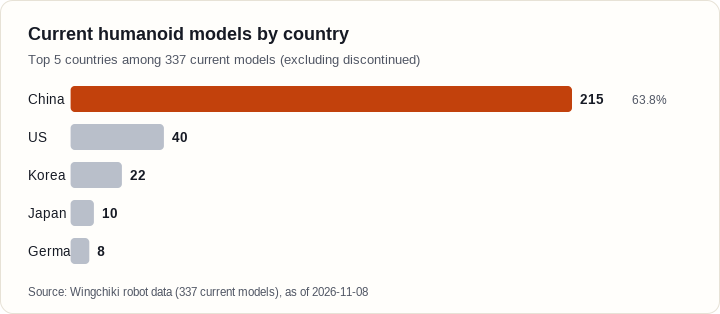
Of the 337 current humanoids in Wingchiki's robot database (excluding discontinued), 215 (63.8%) are made by Chinese companies. That is far ahead of the US (40), Korea (22), Japan (10) and Germany (8). Including parts and AI companies, Wingchiki tracks 165 Chinese companies.
- 215Current humanoids made by Chinese companies63.8% of 337 worldwide
- 77.9%China's share of global shipments in H1 2026IDC count
- 66Chinese models on sale73% of the 91 on sale
- Stage② Prototype 86, ③ Pilot 34, ④ Production 29, ⑤ On sale 66
- Formbiped 115, wheeled upper body 91, hybrid 9
- Purpose (overlapping)industrial & logistics 114, research & education 109, commercial & service 91, home 41, performance & entertainment 28
- New models33 of 46 in 2024, 81 of 115 in 2025 and 79 of 122 in 2026 (to early November) were Chinese
Analysis
2-1. The closer a humanoid is to being sold, the more likely it is Chinese
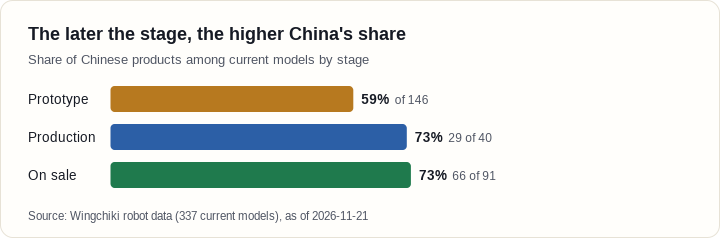
China's share is higher at the sales and production stages. Of all current models, 73% of the 91 on sale (66) and 73% of the 40 in production (29) are Chinese. That is higher than China's share of the 146 prototypes (59%).
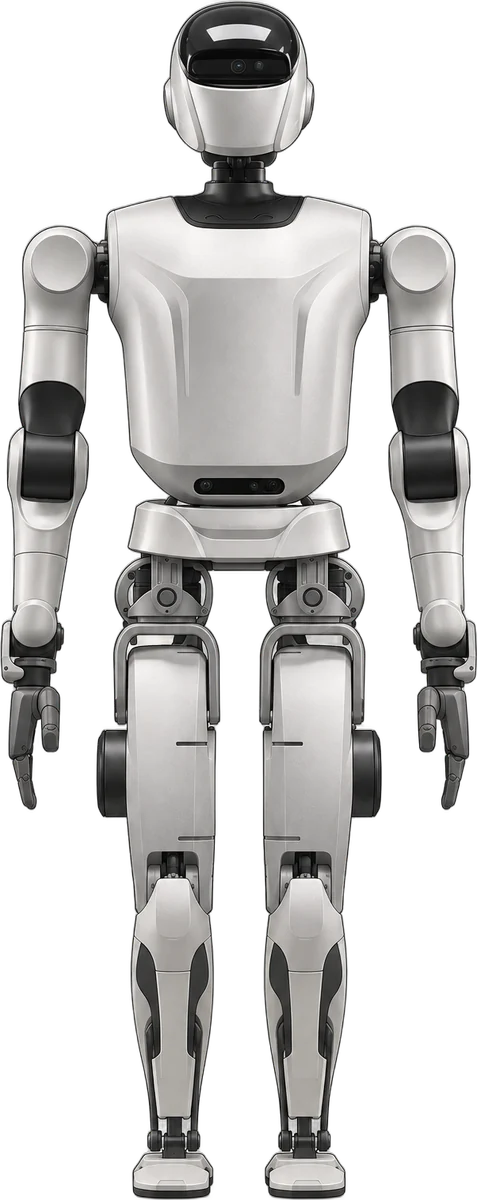
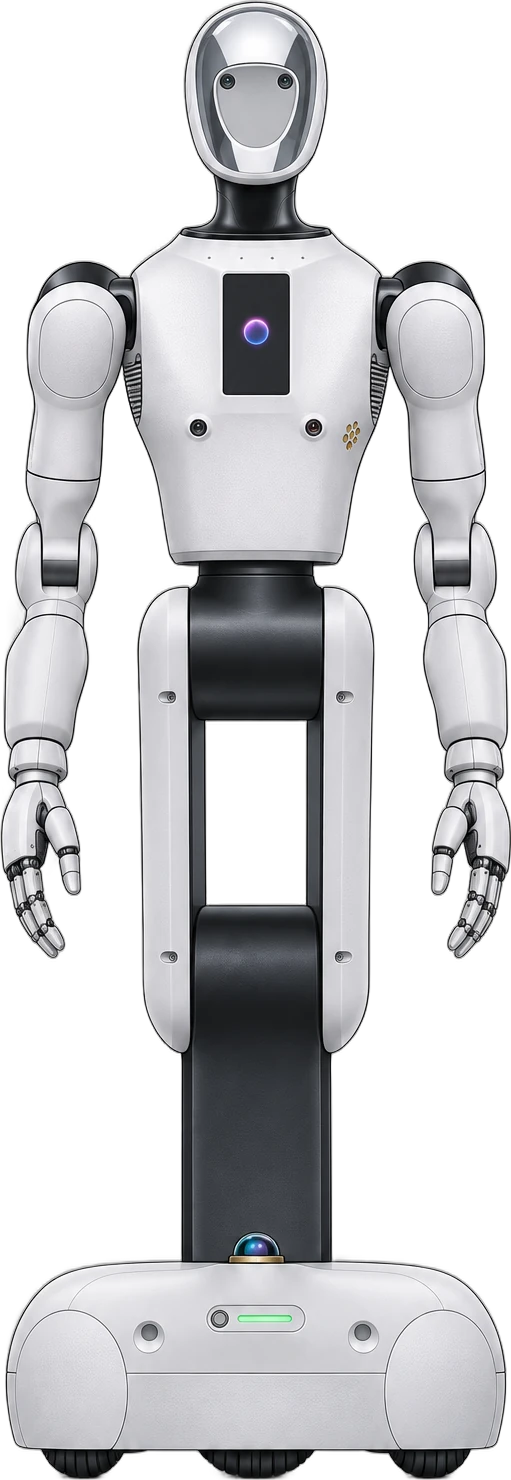
Another feature is the 91 wheeled upper-body robots. They put an upper body and two arms on wheels instead of legs, and like Galbot's Galbot G1 and AgiBot's Genie G2, they are being used first to pick and move items in factories, stores and pharmacies.
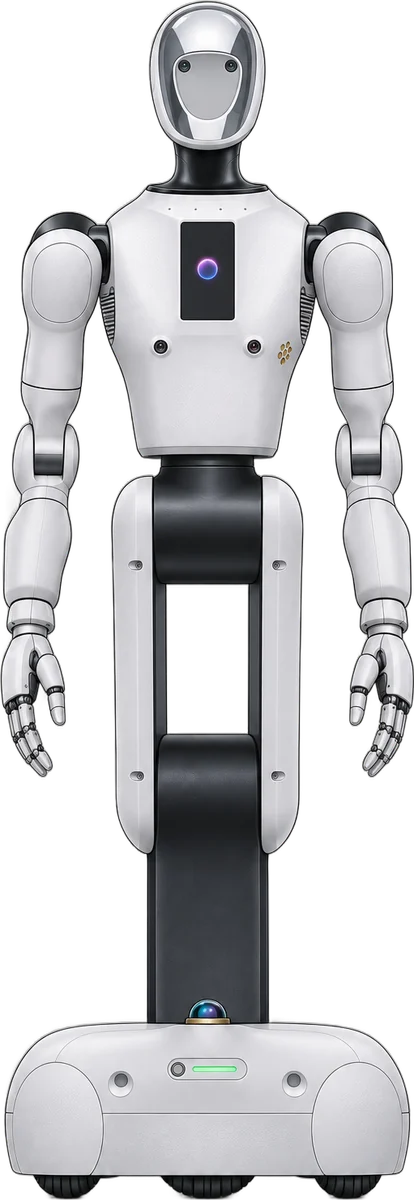 Galbot G1Upper body and two arms on a wheeled base
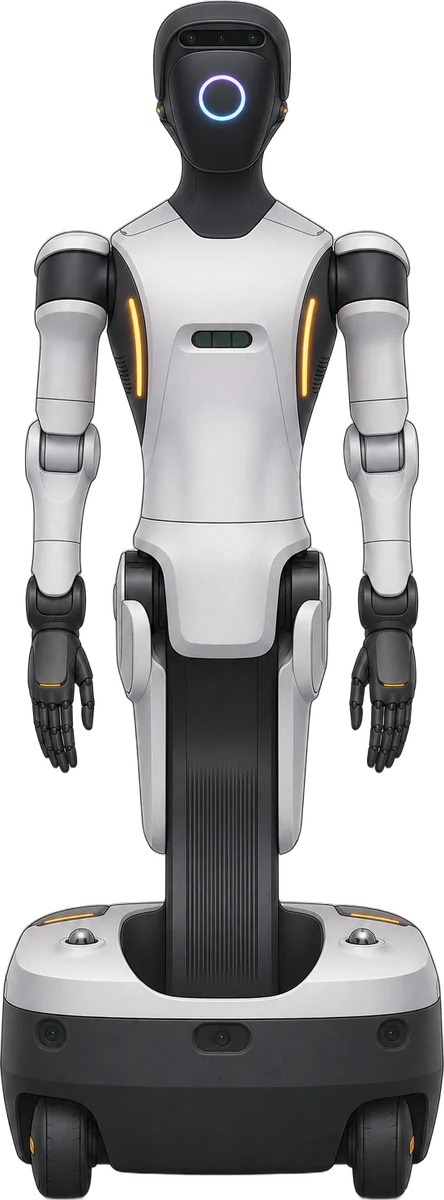 Genie G2Wheeled upper body, built for factories and stores
2-2. The gap is even wider in shipments
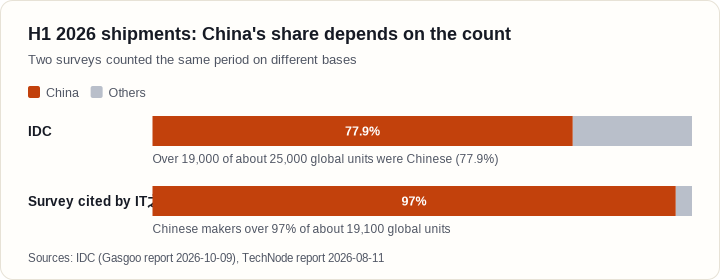
Research firms give different numbers, but they point the same way. All are counts through June 2026.
- IDCof about 25,000 units shipped worldwide in H1 2026 (up 432.1% year on year), China took more than 19,000 (77.9%) (Gasgoo report, 9 October 2026, checked 2026-11-08).
- Survey cited by IT之家of about 19,100 units shipped worldwide in the same period, Chinese makers took more than 97% (TechNode, 11 August 2026).
- Counterpoint Researchsaid H1 2026 shipments grew close to 300% year on year (Counterpoint Research). It also put China's share of about 16,000 installations in 2025 above 80% (Counterpoint 2025 count).
2-3. Shipments are concentrated in Unitree and AgiBot
Most of China's shipments come from two companies. In IDC's count, AgiBot (Zhiyuan) shipped more than 8,600 units in H1 2026, about 35% of the global market and more than 45% of the Chinese market. In Counterpoint's count for the same period, AgiBot took more than 43% and Unitree about 31%. In April 2026, TrendForce forecast that the two companies would take close to 80% of China's shipments this year (TrendForce).
Unitree's core product is the G1, about 130cm tall. Counterpoint named the G1 as the main model driving Unitree's shipments (recorded in Wingchiki's market data). The official price is $13,500 (excluding tax and shipping). Unitree listed on Shanghai's STAR Market on 19 August 2026, raising about 6.1 billion yuan (about $905 million) (Caixin, checked 2026-11-08).
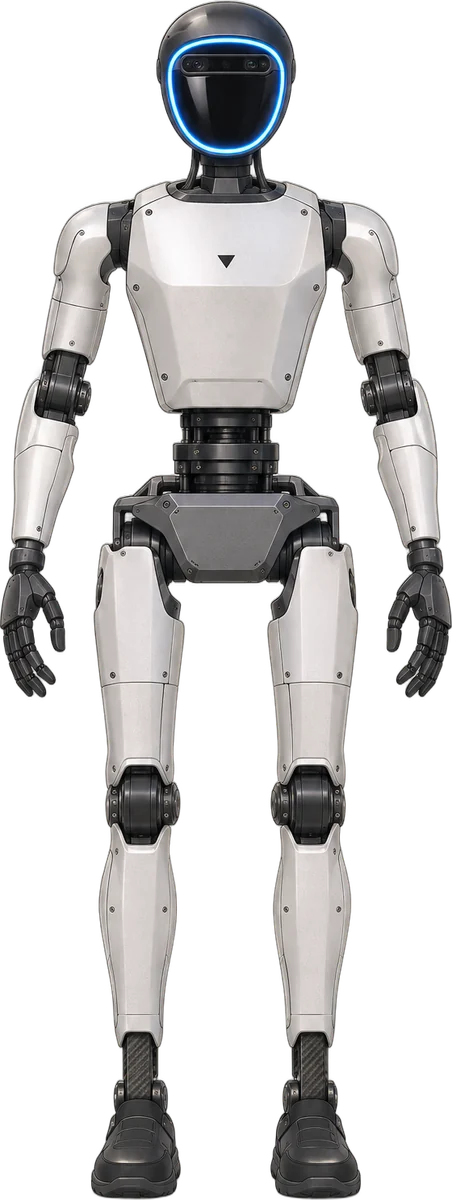
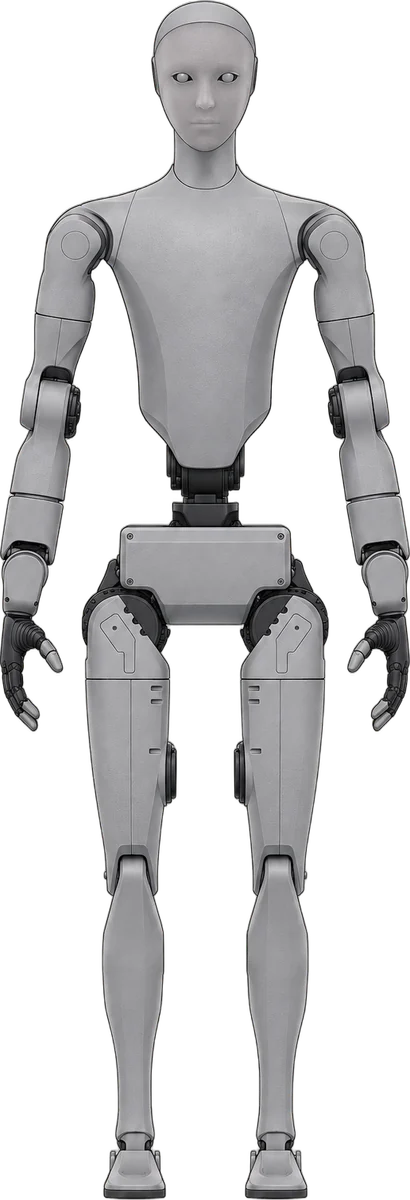
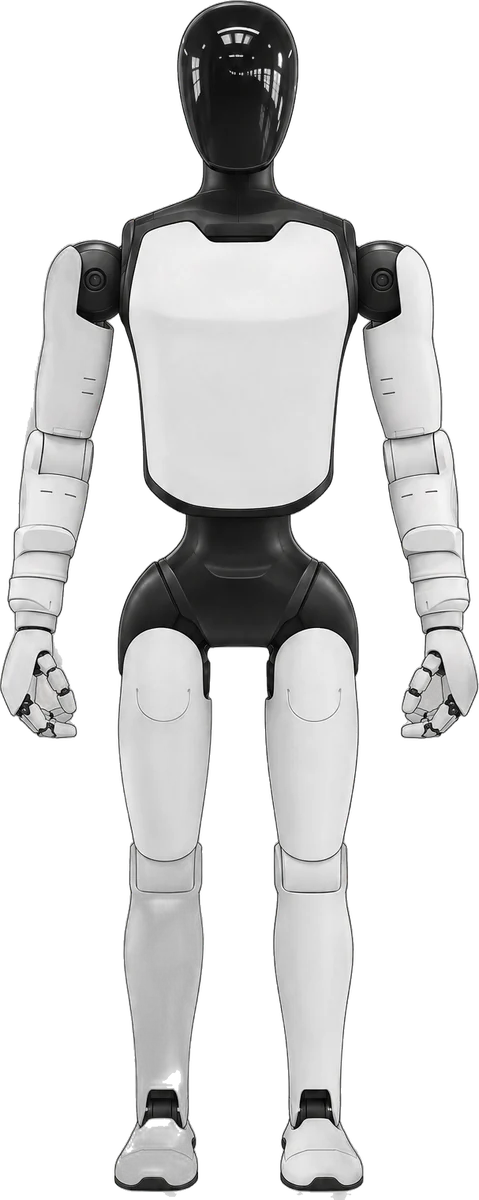
By number of models, Unitree has 7, AgiBot and UBTech 6 each, and Dobot, Galaxea, LimX Dynamics, MagicLab and Ligong 4 each. The Beijing and Zhejiang humanoid robot innovation centers also released 4 each. Public research bodies set up jointly by local governments and companies unveiling robots themselves is something we hardly see in other countries' data.
2-4. China moves fast for three reasons: price, parts and money
The data shows three reasons.
- Many products have a price.Of the 68 robots with a price in Wingchiki's data, 48 are Chinese, and 13 of the 18 under $10,000 are Chinese (from our price report, No. 1).
- Parts are sourced at home.In 51 of the 109 records in Wingchiki's supply chain data, the supplier is Chinese, spread across hands (11), vision sensors (11), screws (6) and reducers (5). Bank of America put the BOM (bill of materials) of a Chinese-made humanoid at about $35,000 in 2025 and below $17,000 by 2030 (Fortune report).
- Investment keeps coming.Looking only at humanoid makers' funding rounds since 2025, excluding IPOs and acquisitions, China has 38 rounds with a median of about $140 million, and the US 9 rounds with a median of about $400 million. China leads in count, the US in size per round (funding report, No. 5).
Government policy is often mentioned too, but this data cannot measure how much policy contributed to shipments, so we do not draw a conclusion on it here.
2-5. Some parts are not yet proven in numbers
For its size, China also has clear weak points.
- 40% are prototypes.86 of the 215 models are still at the prototype stage.
- Shipments mix different uses.A large share are small and mid-sized robots for research, education and performances. Counts of robots replacing people's work on factory lines are rarely published. In one rare disclosed case, Leju's Kuavo moved more than 60,000 parts over about a year at a bearing factory with a success rate above 98%, but took 35–40 seconds per part, more than twice as slow as a skilled worker (about 15 seconds) (Robot Newspaper, 19 November 2026).
- Counts disagree.For the same first half of 2026, figures of 19,000 and 25,000 units, and 78% and 97%, appear side by side.
Conclusion: Wingchiki's view
The following is Wingchiki's opinion based on the data above.
- China has already become "the country that sells the most humanoids".
China leads on model count, share at the sales stage and shipments, and the data shows no sign that this gap will reverse soon.
- But its strength rests on two companies.
Most shipments come from Unitree and AgiBot, so unless companies ranked third and below reach thousands of units, it is hard to generalize this as "China's overall competitiveness".
- The next battleground is factory deployment.
Whether the scale built on research and education sales turns into real deployment numbers and operating hours at industrial sites will be the real yardstick against the leading US companies (from our US report, No. 4).
Indicators to watch
- Whether China's share holds at first-half levels in full-year 2026 shipment counts (expected early 2027)
- Whether companies ranked third and below (UBTech, Galbot, Leju and others) reach thousands of units per half-year
- How many of China's 86 prototypes move to pilot or production, and whether factory deployment numbers are published separately
Data basis and sources: A 2026-11-21 copy of Wingchiki's robot, company, funding and supply data. Countries follow the maker's headquarters, and launch years count only robots with a recorded launch date. Funding amounts add only disclosed deals, so they are smaller than the real totals. The IDC figures (Gasgoo report) and Unitree's listing (Caixin) were rechecked on 2026-11-08. For Counterpoint's first-half shares the full article would not open, so only the headline (about 300% growth) was rechecked; the rest are values recorded in Wingchiki's market data. Stock prices are not covered.